Safari bush flights allow 15 kilograms (33 pounds) per person in soft-sided bags, hand luggage included — some coastal routes allow 20. The workarounds: store city luggage at your Nairobi or Arusha hotel, buy a freight seat for camera gear, pack the family as one weight sheet, and rely on same-day camp laundry. The rule is physics — every kilo rides on a small plane's weight-and-balance sheet.
There is a moment, before dawn at Wilson Airport in Nairobi, when safari travel tells you the truth about itself. A porter lifts your bag onto a hanging scale. The number matters: fifteen kilograms — thirty-three pounds — for everything. Clothes, binoculars, camera, chargers, the paperback you won’t read. And the bag itself must be soft-sided, because a hard shell won’t deform into the belly of a small plane. Travelers who arrive with rigid roller cases watch them stay on the tarmac.
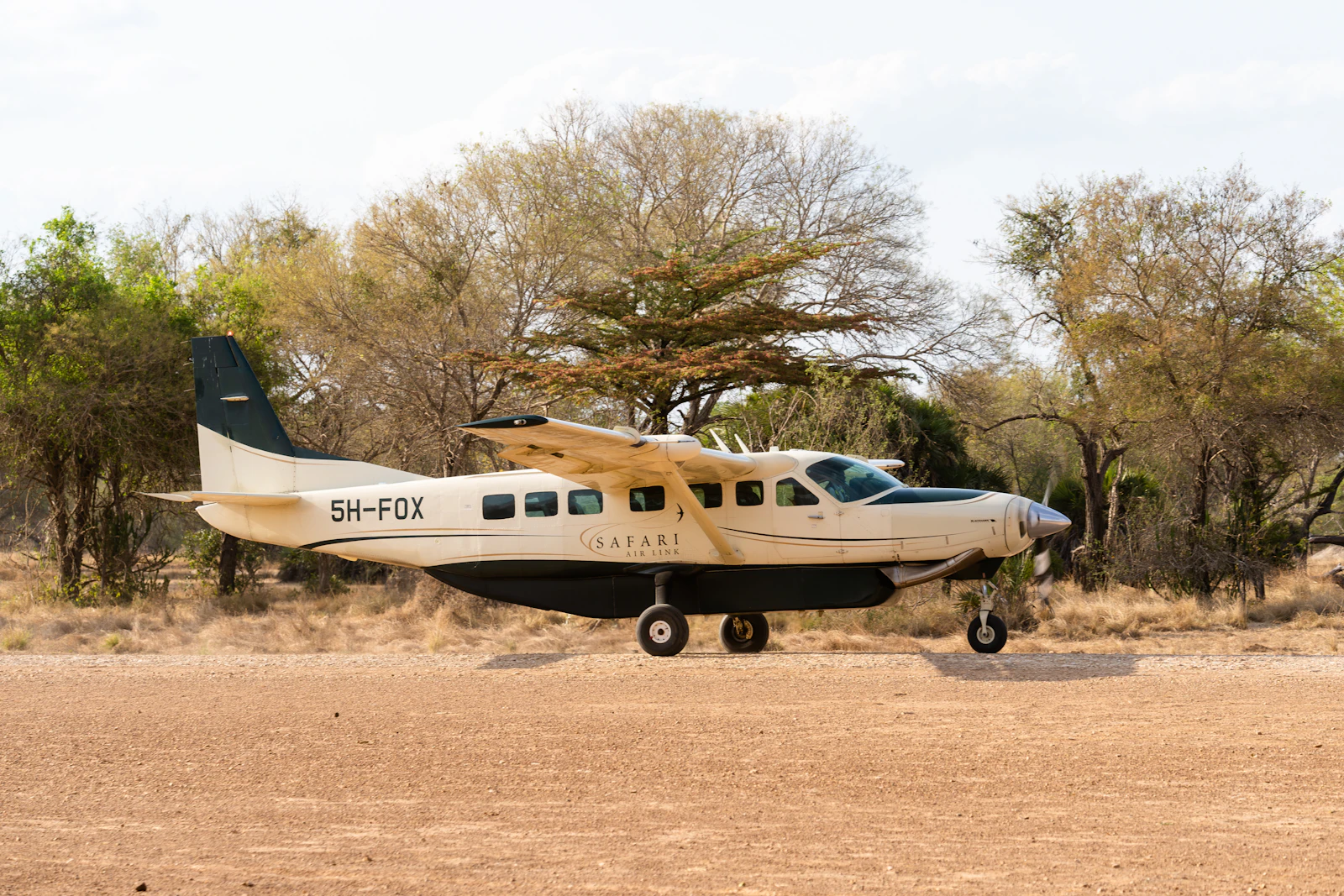
It looks like bureaucratic pettiness. It’s physics. The aircraft that will land you on a dirt strip near your camp is typically a single-engine Cessna Caravan. Warm high-altitude air is thin; bush strips are short; every kilogram on board is traded against fuel and lift. Someone calculates a weight-and-balance sheet for every leg. Your duffel is on it, by name.
En Route Truth: The 15-kilo rule isn’t a restriction on your trip. It’s a window into it — the visible edge of a lattice of physical constraints that governs everything a good safari quietly does for you.
What one number tells you about the whole trip
Pull the thread and the whole system unspools. Bush flights run like milk runs — the 10:40 to your camp may touch two other airstrips first, so a “short flight” is really a sequence, and the sequence is why safari days are choreographed to the minute. Camps do same-day laundry, usually included, because everyone lives inside the same fifteen kilos — four shirts genuinely is enough. The soft duffel exists because cargo rides in a pod under the fuselage shaped nothing like your suitcase.
None of this appears in the brochure, because none of it photographs well. All of it decides whether your trip feels effortless or embattled.
The workarounds the pros use
- Split your luggage. Your city clothes and hard cases stay locked at the Nairobi or Arusha hotel — most good ones hold bags for the safari leg as a matter of course. You fly into the bush with the duffel and return to the rest of your wardrobe.
- Photographers buy a seat. If the lens collection outweighs the wardrobe, the professional move is purchasing an extra “freight seat” for gear. It sounds extravagant until you price a single missed flight.
- Pack the family as a system, not as individuals. Children rarely use their full allowance; adults always exceed theirs. One weight sheet, shared strategically.
- Medication and optics ride with you. Anything the trip cannot survive losing goes in the small bag between your feet — never in the pod.
- Pack for the cold you don’t expect. Dry-season safari mornings are genuinely cold — on the Ngorongoro rim, at 7,500 feet, they’re near-freezing year-round. The fleece earns its kilogram.
The flight is the signature moment
Here’s what the rule buys you. The Caravan climbs out of Nairobi and drops low over the Rift Valley. Giraffe shadows stretch across the escarpment. Twenty minutes later you descend toward a strip of red dirt where zebra graze the threshold and the terminal is an acacia tree. It’s the moment safari travelers come home talking about — we did.
Nobody hires a travel advisor to memorize a baggage rule. You hire judgment so that the rule — and the two hundred constraints behind it, the flight sequencing, the luggage storage, the freight seat booked in March for a lens that arrives in July — never reaches you mid-trip. That’s the invisible work. It’s all we think about.
If your safari plan has a bush flight in it, send it over. We’ll check the seams — the weight limits, the connections, the gaps between bookings where trips actually break — and tell you what to fix while it’s still fixable.
Fair Questions
What is the luggage limit on safari bush flights?
Typically 15 kilograms — 33 pounds — per person in soft-sided bags, hand luggage included; some coastal routes allow 20. Hard-shell cases are refused because they don’t fit the cargo pods of small aircraft.
What if you need more than 15 kilos?
Two moves: leave the city luggage locked at your Nairobi or Arusha hotel and fly the bush leg with a duffel, or buy an extra ‘freight seat’ at adult fare for camera gear — the standard workaround for photographers.